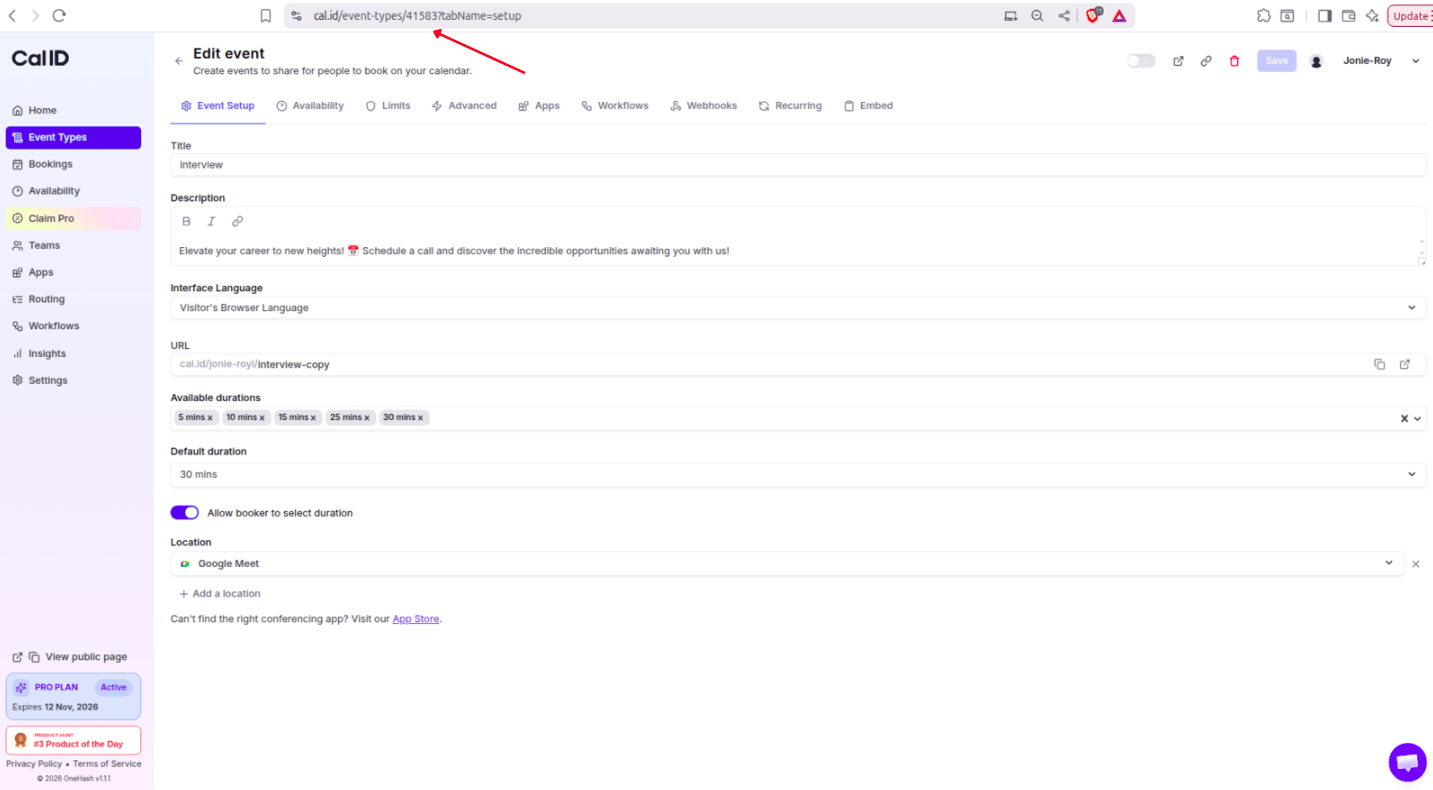
Read the unique numeric ID of any event type straight from your browser’s address bar, so you can reference it in API calls, webhooks, and integrations.
Every event type in Cal ID has a unique numeric Event Type ID. You need it whenever you call the API, wire up an advanced integration, or troubleshoot a specific booking workflow. You do not have to look it up in the API — it is visible in your browser’s address bar while you edit the event.
Need every ID at once? Call GET /event-types/ — but remember it returns only 10 results by default, so pass an explicit limit such as ?limit=100. See API integration for the full list of conventions.
API integrations — target a specific event type when creating bookings or reading slots.
Webhooks — identify which event type fired a notification from the eventTypeId field in the payload.
Custom styles — apply CSS or scripts to one particular booking page.
Support — our team may ask for the ID to investigate an issue with a specific event.
If you juggle several IDs on a team project, keep a simple sheet mapping each event name to its Event Type ID. It saves clicking into every event type each time you need one.